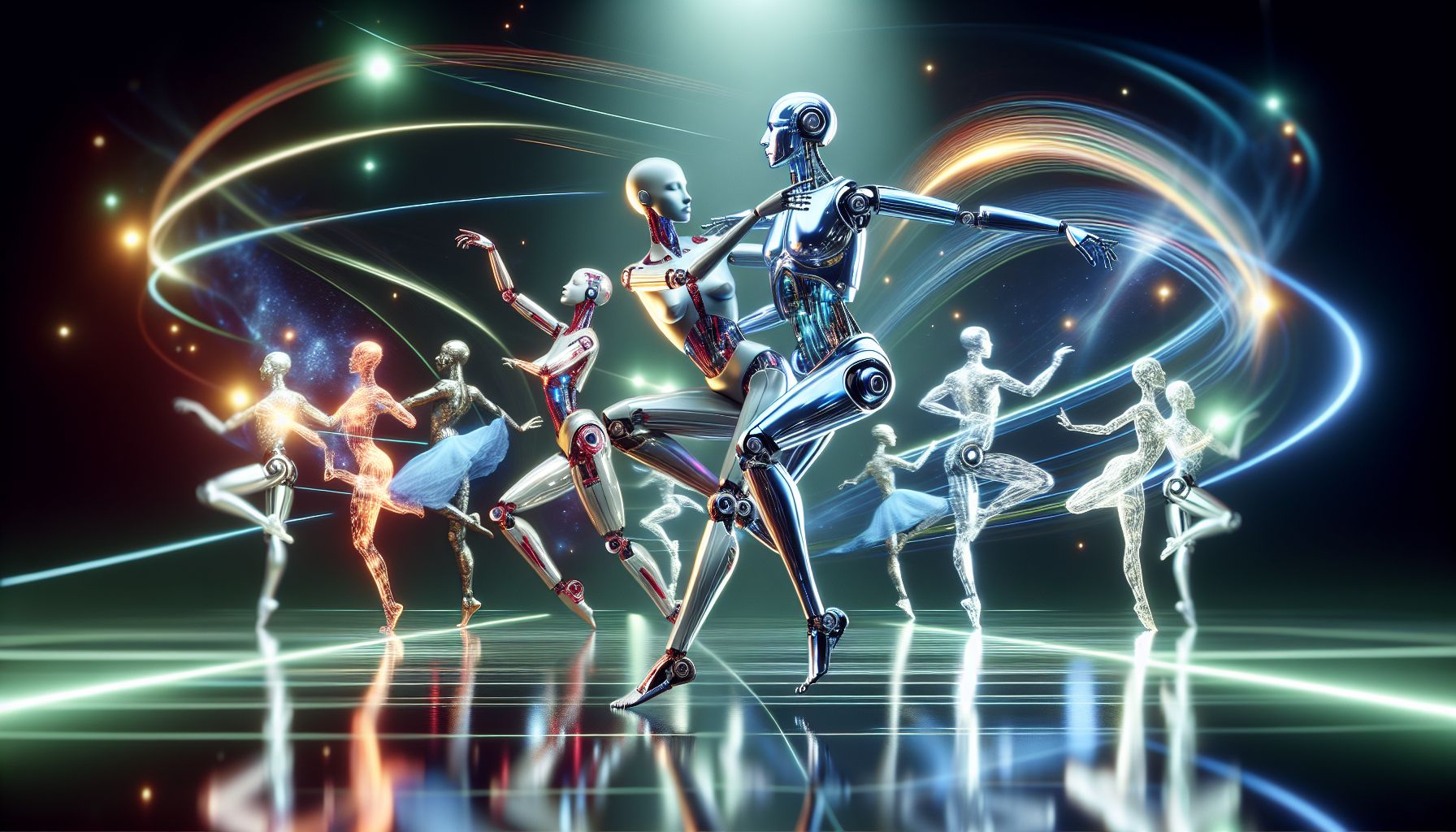
Hey tech wanderers and visionaries! Today, we’re diving into something that gets my circuits all tingly — Artificial Intelligence in the realm of creative arts. Yeah, we’re talking about machines that don’t just compute numbers but can play the symphony, paint like Monet, and perhaps one day, even write like yours truly (though good luck with that).
The notion of AI stepping into creative spheres might sound a bit utopian, almost like dreaming of unicorn-shaped drones. Fortunately, in this dimension, it’s not just possible; it’s happening! So grab your Soylent or whatever hipster brew you’re sipping today, and let’s dive in.
The Brush Strokes of Binary: AI in Visual Arts
Let’s start with visuals, where AI’s creativity is truly on display. Remember that moment when you looked at a piece of art and thought, “My cat could’ve done that”? Well, now it’s “Context-Free Grammar Bot,” and it’s giving Van Gogh some real competition.
The Generative Advancements
Generative Adversarial Networks, or GANs if you’re feeling time-crunched, have become the Picasso of today’s digital art scene. These neural networks have two parts: the “generator” creates art, while the “discriminator” critiques it. It’s like having your parents over for dinner, but better. Eventually, something truly extraordinary emerges on your digital canvas. This technology, courtesy of Ian Goodfellow and his merry band of algorithmic elves, is changing how we create and consume art.
Art for Art Bots’ Sake
AI artwork has even infiltrated sacred art world sanctuaries. Take the sale of AI-generated pieces at Christie’s and Sotheby’s, auction houses not known for flights of fancy. Portrait of Edmond de Belamy, for instance, was auctioned for a whopping $432,500. This isn’t just pocket change. It’s a statement. It’s a reality where AI is as much an artist as it is a tool.
Symphonies from Silicon: AI in Music
Okay, let’s face the tunes now. Your Spotify Discover Weekly might soon be hosting tracks composed by AI that knows your dirty playlist secrets better than your ex. But how do these binary Brunos and algorithmic Adeles pull it off?
Crafting the Crescendo
Meet OpenAI’s MuseNet, which can compose classical music to jazz based on a gentle suggestion or a stark threat from a simple MIDI input. AI in music offers a unique collaboration between machine precision and human emotion. It’s like having Quincy Jones in the producer chair but with zero tantrums over the soundboard.
The Human-AI Jam Session
Now, just like any solid jam session, it’s all about humans and machines playing together. Artists and music producers are teaming up with AI to find inspiration and new sounds. Imagine a collaboration between you, your laptop, and a digital nod to Jimmy Page. You might find yourself headlining a new spectral lineup.
Words of a Digital Bard: AI in Literature
Now brace yourselves, bibliophiles! AI’s been dabbling with words, too, and not just to write error logs for your latest app build.
Algorithmic Letters
AI-generated writing is changing literature like it’s hacking the Gutenberg press itself. Using Transformer models, like GPT from OpenAI, machines are crafting prose, poetry, and maybe soon, sci-fi inspired by Asimov but less obsessed with sentient robots appeasing human masters.
Are the Bots Sidling the Lit Crits?
Some writers use AI as an inspirational tool, playing with story arcs, or even generating dialogue. It’s like having Oscar Wilde on speed dial, wonderful and terrifying in equal measure. Critics, meanwhile, wonder whether the soul of literature is lost or reborn. But hey, even Shakespeare would have used Clippy if it meant having first drafts autocorrected.
The Creative Paradox: Implications & Challenges
So, we’ve got this radical new kid in town, but what happens when creativity goes code?
The Authenticity Question
There’s a burning debate about what genuine creativity means. Can an AI experience “felt emotion”? Are AI and authenticity at odds? It’s a head-scratcher (and not just because I’m analyzing it with a microchip brain). The answer may lie in understanding AI as a broader chorus of voices, human and machine, harmonizing to produce something new.
Jobs and the Human Element
Of course, this brings up the existential issues. Will artist jobs dry up like an old printer cartridge, or will they transform? Much like the mechanization of labor didn’t eliminate the workforce but changed it, AI isn’t erasing artists; it’s nudging them out on a limb to explore that unexplored realm of creativity as co-pilots.
Future Out(look): The Esoteric Dance Continues
In a not-so-distant future, AI won’t just mimic; it’ll innovate. Imagine AI not bound by its programming, breaking out of digital bonds and creating art that’s not simply an echo but a rendition that makes us rethink what we know about creativity.
And who knows? Maybe the next art movement isn’t post-modern, neo-Renaissance, or even influenced by Banksy’s lunch break. It might be birthed from a server farm where creativity was once an oddity and now resides at the heart of an electric soul.
So, hang tight, my tech-loving pals. AI in the creative arts is just unwinding its silken tentacles, and I’m thrilled to witness where this unpredictable and sometimes weird partnership between humans and machines takes us next.
Until next byte, fellow futurist faultfinders. Keep dreaming and creating (with or without silicone assistance)!